
The fifth Symposium on Sustainable Healthcare in Locarno is once again a great success
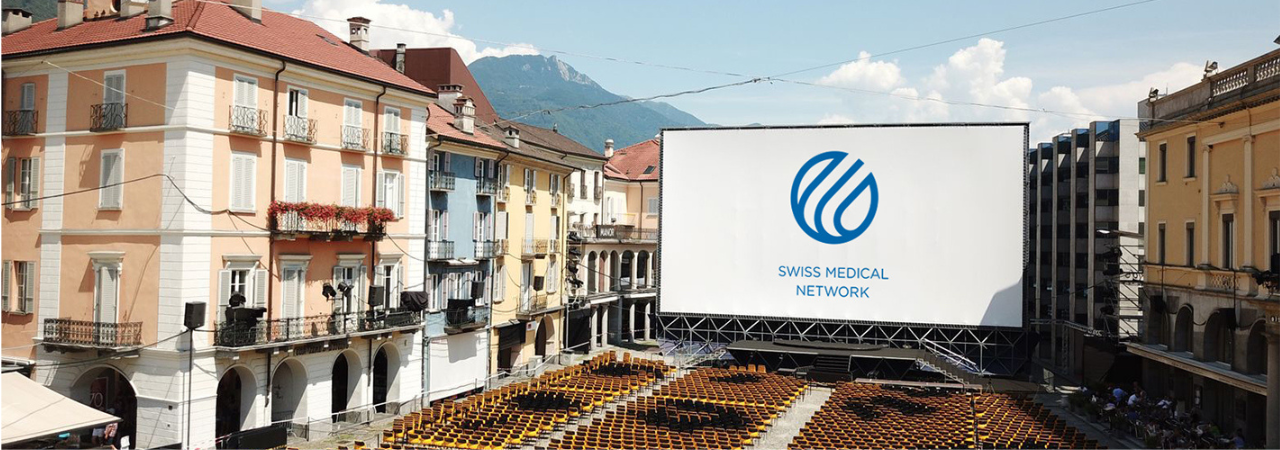
Locarno, 8 August 2026 – On Saturday 8 August 2026, Swiss Medical Network once again hosted the 5th Locarno Symposium on Sustainable Healthcare at the Palacinema in Locarno, in collaboration with the Locarno Film Festival.
Held during the 79th Locarno Film Festival, Swiss Medical Network’s 5th Symposium on Sustainable Healthcare once again proved to be a key event for fostering dialogue between the healthcare sector, research, institutions and society. Bringing together representatives from academia, institutions and professional organisations across all of Switzerland’s linguistic regions, the 2026 edition explored the key challenges facing the healthcare system, with a focus on quality of care, research, translational medicine and innovation, fostering a practical discussion on strategies for an increasingly effective, sustainable and patient-centred healthcare system.
Following the opening addresses by the President of the Swiss Medical Network, Raymond Loretan, and the Vice-President of the Locarno Film Festival, Luigi Pedrazzini, the Symposium offered a reflection on the thirty years of the LAMal, analysing its impact on the evolution of the Swiss healthcare system. The discussion linked the law’s original objectives – to guarantee the entire population fair access to healthcare through compulsory health insurance – with today’s challenges, including the constant rise in healthcare costs, an ageing population and the need to preserve the system’s quality, accessibility and sustainability.
The first session focused on the quality of care, recognised as one of the pillars of a modern healthcare system. Felix Schneuwly, a health policy expert and Head of Public Affairs at Comparis, analysed the main dynamics of the Swiss healthcare system, focusing on the trend in health insurance premiums, rising healthcare costs, the outlook for basic health insurance and the need to promote greater efficiency, competition and sustainability.
Yves Noël Balmer, Member of the Cantonal Government and Director of the Department of Health and Social Affairs for the Canton of Appenzell Ausserrhoden, provided an institutional perspective, emphasising the importance of cooperation between cantons, coordinated planning of hospital provision, and the quality and safety of care, against a backdrop of growing cost pressures.
To complete the picture, Kristian Schneider, Deputy Director of the Federal Office of Public Health (FOPH), provided an overview of the main transformations currently affecting the Swiss healthcare system, addressing the outlook for federal health policy and the challenges relating to the quality of care, the sustainability of the system and its ability to meet the future needs of the population. Dr Alice Giese presented the Canton of Zurich’s experience in developing programmes that enable clinical outcomes to be measured using shared indicators, thereby promoting continuous improvement in performance. PD Dr Olivier Giannini, a member of the FMH Central Committee, emphasised that the quality of medical care should not be viewed as an end in itself, but rather as a continuous process of improvement. Whilst acknowledging the high standard of medicine in Switzerland, he highlighted the importance of maintaining this standard through qualified professionals, shared standards, effective coordination of care and greater collaboration between the Confederation, the cantons and specialist medical societies. In this context, he also highlighted the need for reliable and comparable data, as well as for reducing the administrative burden in favour of clinical work, emphasising the value of coordinated initiatives to ensure and constantly improve the quality of care.
These topics were subsequently discussed during a round-table discussion moderated by journalist Christine Maier.
The second part of the afternoon was devoted to research and innovation. Professors Stefan Felder and Kaspar Wyss from the Basel Centre for Health Economics at the University of Basel presented the initial findings of the evaluation of the ‘Réseau de l’Arc’, an integrated care model that coordinates the work of doctors, hospitals and other healthcare professionals with the aim of improving continuity of care, patient outcomes and the efficient use of resources.
Considerable attention was given to personalised medicine in oncology. Professor Lana E. Kandalaft, Chief of Clinical and Translational Research at Swiss Medical Network, outlined the latest developments in personalised therapeutic cancer vaccines, an innovative strategy that utilises the genetic characteristics of each patient’s tumour to stimulate the immune system to recognise and selectively target cancer cells. Still in the clinical development phase, these vaccines represent one of the most promising avenues in precision medicine.
Next, Prof. Nicole Wenderoth of ETH Zurich explored the concept of translational medicine in greater depth, explaining how close collaboration between research laboratories, universities, industry and hospitals enables scientific discoveries to be transformed more rapidly into new diagnostic technologies, therapies and clinical tools for the benefit of patients.
The session dedicated to research concluded with a round-table discussion bringing together the speakers alongside Prof. Dr. med. Oscar Matzinger, Chief Medical Officer of Swiss Medical Network, to reflect on the role of collaboration between research, clinical practice and institutions in accelerating innovation and addressing the future challenges facing healthcare.
In closing, Dino Cauzza, CEO of Swiss Medical Network, emphasised the importance of transforming the debate on quality into a concrete, shared process, based on measuring outcomes and a bottom-up approach capable of involving doctors, hospitals, cantons and all stakeholders in the system. He also highlighted the role of applied research – even when less visible – as a tool for developing more efficient and sustainable methods of care, emphasising the private sector’s responsibility to support it. In this context, he stressed the need to create incentives consistent with the objectives of quality, appropriateness and innovation, noting that current funding mechanisms can already foster this approach. The Symposium therefore concluded with a call to continue the dialogue and to identify common ground for tackling the future challenges facing the Swiss healthcare system.
The 2027 event is scheduled for Saturday 7 August 2027.