close search

How can we help you?

Top searches

Jobs
Radiology
Physiotherapy
Oncology
Apprenticeship
Management
Gynecology
Ergotherapy
Radiotherapy
Mri
Neurology
Neursurgery
17.09.2026

Day 4 – Transfers

Transfers: a critical moment for patient safety

This article is part of our series dedicated to International Patient Safety Week 2026, which focuses on non-communicable diseases. You can find all the articles from this week here. 

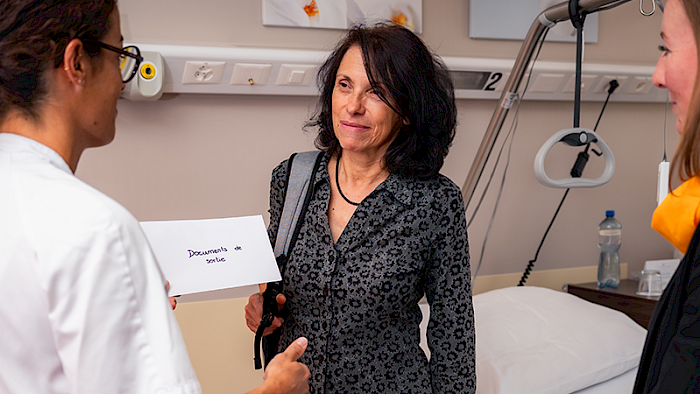
Yesterday, we discussed the active role of patients. Today, we are focusing on the moment when responsibility passes from one department to another: the transfer. Admission to hospital, discharge, or transfer to another facility. It is precisely at these junctures that many of the risks associated with care arise, but also where the best opportunity lies to avoid them.

Five principles for a secure transfer

1
Completeness takes precedence over speed.

A quick but incomplete transfer requires more effort than it saves.

4
Patient involvement.

Patients need to understand their treatment and the next steps.

2
Clear responsibilities.

At each handover point, it is important to clearly identify who is responsible.

5
The right moment.

A transfer must take place in good time, not after the event.

3
The right channel of communication.

In complex cases, written documentation is often not enough. A brief verbal discussion can help to fill in the gaps.

Admission to the clinic: what to bring 

  • Current and suspected diagnoses, including the reason for admission 
  • A complete list of medications and their dosages 
  • Allergies and intolerances 
  • Relevant medical history: previous operations, chronic conditions, complications 
  • Tests already carried out and their results, to avoid duplication of tests 
  • Contact details of the attending doctor 
  • Social factors influencing treatment, such as living alone, language barriers or the need for support 
  • Advance directives 

Discharge from hospital: what needs to be sent 

  • Forward the discharge report in a timely manner to the patient’s GP or the doctor responsible for their follow-up care, ideally on the day of discharge 
  • In the event of transfer to another hospital: significant events that occurred during the stay and the patient’s general condition on discharge 
  • Changes to treatment clearly communicated: what has been added, stopped or altered, and why 
  • Next practical steps: who does what, and by when 
  • Warning signs: when should patients get in touch again, and with whom? 
  • A clear explanation for the patient: what has been done, what will happen next, and which medicines have been changed 
  • A clearly designated contact person until the first appointment with the GP 

Golden Rule

A handover is only secure if nothing is left to chance.

Read more about the Patient Safety Week

Day 1 – Prevention

Day 2 – Support for people with NCDs

Tag 3 – Patient Empowerment

Day 4 – Transfers

Day 5 – Integrated Care (VIVA)

What is the most important contribution a patient can make to their own health?

What is the first step towards taking an active role in managing your own health?

What advice would you give to someone who has just been diagnosed with a chronic condition?

What small dietary change can have a significant impact on health?